2026-06-24 · 3 MIN READ
Owning the IP line
Shipping a game on Steam means owning every name in it. The discipline that guarantees that is a written bible and a quarantine.
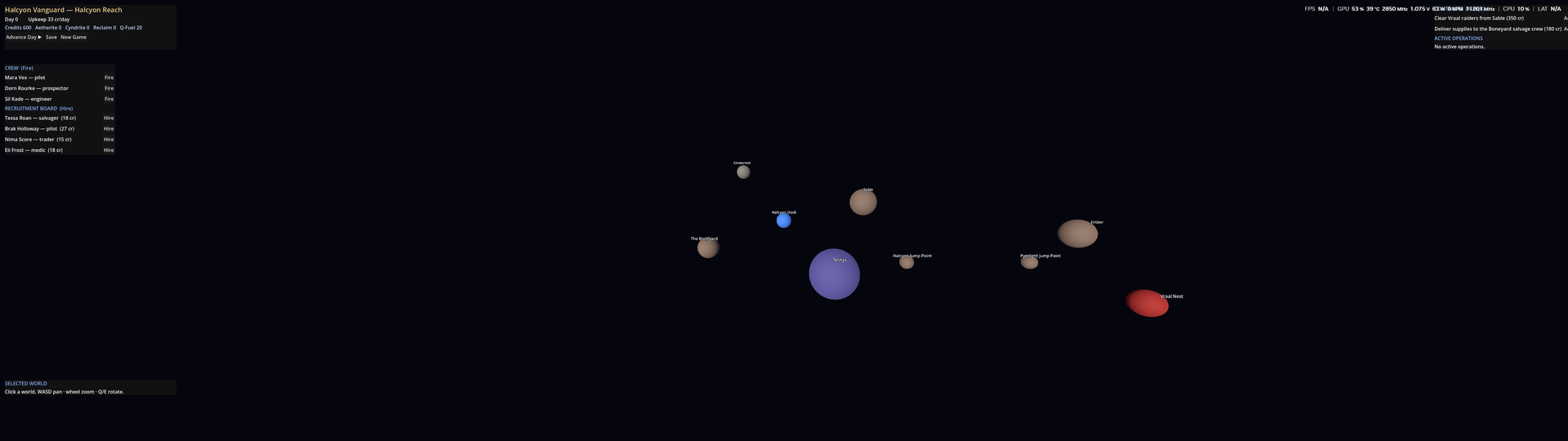
A game inspired by another universe is easy to start and impossible to ship. The moment a faction, a ship, or a manufacturer name is borrowed, the project is no longer yours to sell, and that contamination spreads quietly — a placeholder name here, a reference asset there, until the line between homage and infringement runs straight through your codebase and you cannot find it anymore.
Both of my strategy games draw on a genre with a strong house style, so I drew the ownership line on purpose and wrote it down. Every player-facing name — factions, ships, manufacturers, resources, locations — is original and lives in a single IP bible that defines the boundary explicitly. The bible is the source of truth: if a name is not in it, it does not ship. Reference material from the games that inspired the work is quarantined as inspiration only, kept out of the build and clearly marked as not-for-use.
The discipline is what makes the result clean to ship. or9.space, the continuous-scale game, and VerseCommand RTS, the standalone skirmish build, each own all of their IP and are clear to put on Steam with no borrowed universe riding along. Keeping the two as separate builds with separate bibles is part of the same hygiene — the continuous-world game and the skirmish game do not share names they should not share.
The broader point is that ownership is not a thing you check at the end. It is a constraint you build under from the first commit, enforced by a document you actually maintain. A bible written on day one costs an afternoon. A borrowed name discovered the week before launch costs the launch.
- 01
- 02VerseCommand RTS — project page
The standalone skirmish build with its own IP bible.
/projects/versecommand-rts
- 03