2026-06-24 · 4 MIN READ
One zoom, no seam
A game that runs from one deckhand mining ore by hand up to an empire of fleets, with no loading screen between the scales.
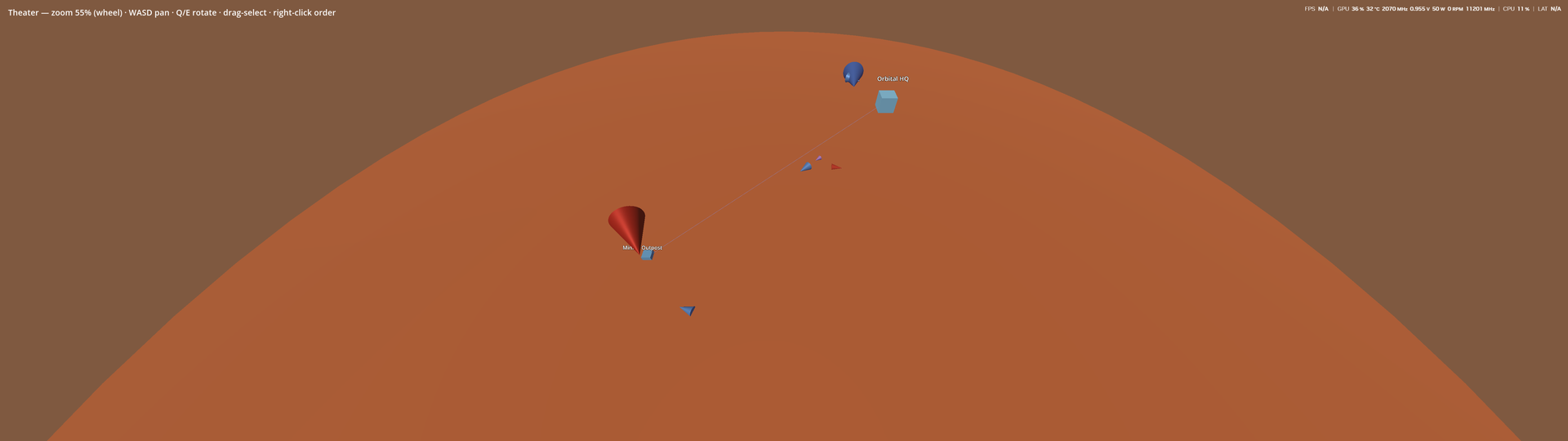
The wall between an action game and a strategy game is usually a loading screen. You play the shooter, then you load the map, then you play the strategy layer, and the two halves never share a frame. or9.space removes the wall: one continuous world and one continuous zoom, from on foot inside a ship, out to the hull, into the air, up to orbit, out to the galaxy map, with no loading seam between any of the scales.
You start at the bottom of it. The opening avatar is a deckhand hand-mining ore for credits. The first ship is something you buy, broke, and outfit from nothing. From there the ladder runs up — hire crew, man the pilot, gunnery, engineering, and mining stations aboard a walkable interior, then stop flying every ship yourself and start delegating to crews that run missions while you look elsewhere. The same continuous world holds the whole climb.
Once you are delegating, attention becomes the scarce resource, and that is the actual game. Persistent theaters — one per moon or location — keep simulating in real time whether or not you are watching, and the strategic galaxy layer ticks economy, supply, and faction war on its own clock. A front you ignore can fall while you are mining on the other side of the map. The design pressure is no longer 'can you win the fight' but 'where do you spend the one thing you cannot scale.'
Movement is genuinely spherical, which is the part that took the most rigor. Real-time units travel great-circle paths across procedural terrain globes with no navmesh, backed by a unit-tested GlobeMath core that every move, placement, and build runs through. Combat is EVE-flavored fleet tactics — grouping, swarm movement, coordinated fire — across five original factions and ten-plus ship roles. It is Godot 4.6 and GDScript, around seventeen thousand lines, built continuous from the first commit rather than stitched together from separate modes.
- 01or9.space — project page
The continuous-scale RTS, its theaters and spherical movement.
/projects/or9-space
- 02Owning the IP line
Companion: the original-IP discipline that keeps it Steam-clear.
/blog/owning-the-ip-line
- 03VerseCommand RTS — project page
The standalone skirmish sibling, kept deliberately separate.
/projects/versecommand-rts
- 04