2026-06-24 · 3 MIN READ
The swarm on your face
Agent status and a push-to-talk assistant on a pair of smart glasses — which works because the glasses are the last inch, not the logic.
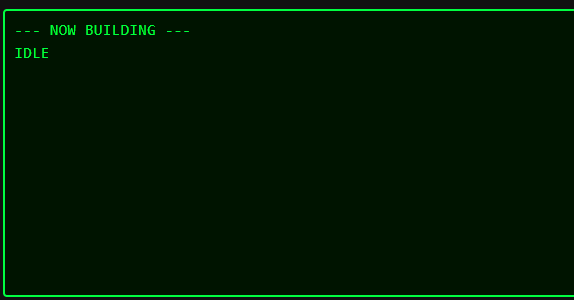
A pair of smart glasses gives you a 576-by-288 monochrome strip and a tap on the temple — that is the entire surface. G2 Hive puts my AI swarm on it. In board-glance mode it polls the swarm and renders live status there: a NOW page with in-progress tasks and who owns them, a QUEUE page with what is ready and what is next, and a STATS page with tasks done, cost, and test pass rates. A single tap on the temple cycles the pages, so the state of a working fleet is a glance up and away.
Double-tap and it stops being a readout and becomes a conversation. Push-to-talk captures audio, ships it for transcription, and streams the swarm's reply back sentence by sentence, with the reasoning traces — thought, delegate, synthesize — surfaced as they happen. The whole thing is a state machine: idle, listening, transcribing, thinking, streaming, and back to idle, with the glasses showing where in that loop you are.
The display is the constraint and the design at once. Twenty-five characters to a line, four-bit greyscale, no pointer. Text is uppercase ASCII, and where the firmware font is missing a glyph the renderer falls back to hex-cell headers instead of rendering a blank. There is nowhere to hide a bad layout on a screen that small, which forces the interface down to only what matters.
What makes it tractable is that the glasses are the last inch, not the brains. The page builders and the push-to-talk transitions are pure functions, fully unit-tested with no glasses and no network in the loop; only the microphone capture and the canvas render are hardware-only. When the glasses bridge is absent it degrades to a browser preview with a keyboard standing in for the temple tap, so the entire app develops and tests in a tab. It is built on the EvenHub G2 SDK in TypeScript, verified in the browser preview, and not yet run on physical glasses.
- 01
- 02
- 03A roguelike on your face
Companion: the same 576×288 display, a different app.
/blog/roguelike-on-your-face
- 04