2026-06-15 · 3 MIN READ
A roguelike on your face
Building a full Balatro for smart glasses, where the display is 576 by 288 pixels of monochrome and the only input is a tap.
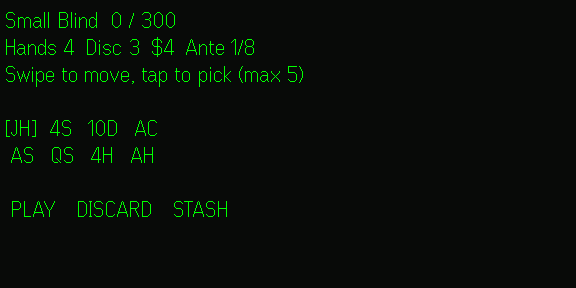
A roguelike deckbuilder on a pair of glasses is a bad idea by every normal measure. The display is a postage stamp, the color depth is four bits of grey, there is no pointer and no keyboard, and the only input is a handful of taps on the temple. I built a full one anyway, and the constraint turned out to be the design rather than the obstacle.
The numbers set the rules. Five hundred and seventy-six by two hundred and eighty-eight pixels, monochrome, about twenty-five characters to a line. Everything Balatro needs to show — a hand, the running score, the shop, a wall of jokers — has to fit and read at a glance, on a screen floating in your vision. The suit symbols are not even in the firmware font, so cards fall back to plain letters. There is nowhere to hide a bad layout.
What makes it tractable is the architecture, not cleverness on the glass. The engine is a pure functional core with the glasses SDK and the Bluetooth calls quarantined in a thin bridge at the edge, so the whole game — thirty jokers, the real chips-times-mult scoring pipeline, the shop, the boss blinds, save and resume — is headless and testable, and 136 tests run it with no glasses in the loop.
Here is the part I did not expect: the tiny screen made the game better to reason about. A display that small forbids decoration. Every element has to earn its pixels, which forces a clarity about what the game actually needs to communicate that you would never bother to find on a phone, where there is always room for one more flourish. The limit is a design partner, not a tax. The cost is honest too: a game that fits on glass you can see through gives up everything that sells a screenshot, no juice, no particle storm, just the loop.
The best reason to build for weird hardware is that it makes you honest. Strip a game down to what fits on glass you can see through, and what is left is the part that was always doing the work.
- 01
- 02
- 03
- 04