2026-06-24 · 4 MIN READ
Forty panels, one function
An ops dashboard that runs as my wallpaper and never reflows on a data tick — because placing the panels is a pure function, not a hand-built layout.
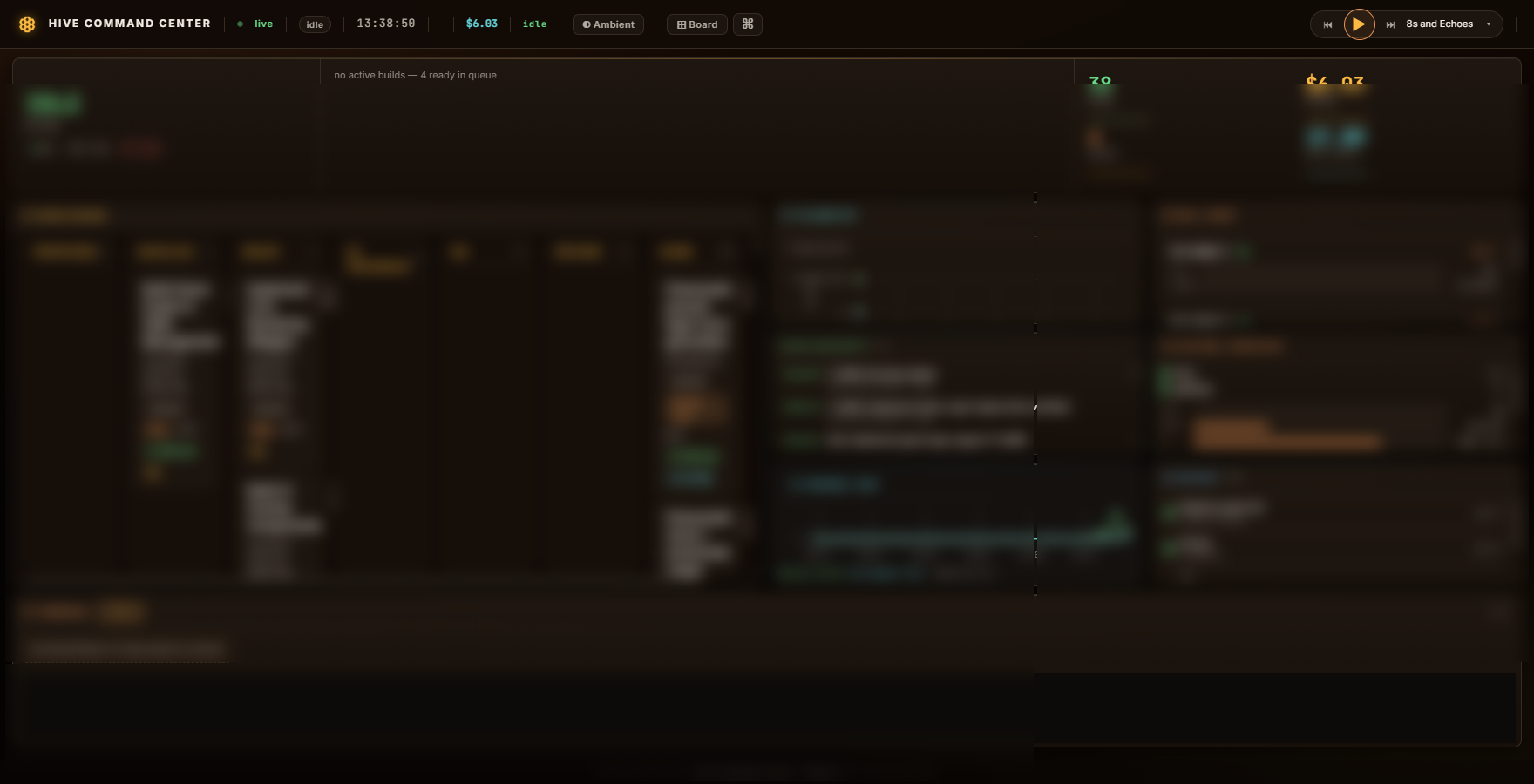
The state of a working AI swarm is something you want to glance at, not open a window for. So the Hive Command Center runs as a live animated wallpaper behind everything else on a 5120-by-1440 ultrawide, with every agent always one look away: a crew-board kanban with live task state and stalled-task detection as the hero, surrounded by per-card GPU utilization and VRAM, Docker service health as red and green dots, a git activity log, an escalations rail, a panel for reviews waiting on me, and a multi-session terminal running real shells.
Forty-plus panels on a dashboard that updates constantly is a layout problem with a trap in it. The naive version hand-places boxes, and the moment a data tick changes one panel's size, everything reflows and the whole board jumps while you are reading it. A dashboard you watch all day cannot twitch every time a number updates.
So placement is a pure function, not a hand-built layout. Every enabled panel self-registers as a plugin, and a single function packs the whole set into a twelve-column, three-band grid deterministically. The same inputs produce the same arrangement, so a data tick that changes a value never moves a box — only hand-toggling a panel on or off re-packs the grid. Forty panels stay still while their contents stream.
It has two minds for the same reason a wallpaper has to be polite about resources. Ambient mode is a read-only glance view that pauses motion and suspends the heavy renderers, so it costs almost no GPU while it sits behind your windows; focus mode wakes it into an interactive console, and a resource governor backs off polling on its own when nothing is changing. The look is the warm-black, OKLCH-amber language the whole Hive family shares — copper and cyan reserved for live signals — built in plain TypeScript and Vite with uPlot and D3 for the charts and no framework at all.
- 01Hive Command Center — project page
The wallpaper ops dashboard, its grid engine and panel plugins.
/projects/hive-command-center
- 02
- 03Theming as a product
Companion: the OKLCH token language shared across the Hive family.
/blog/theming-as-a-product
- 04